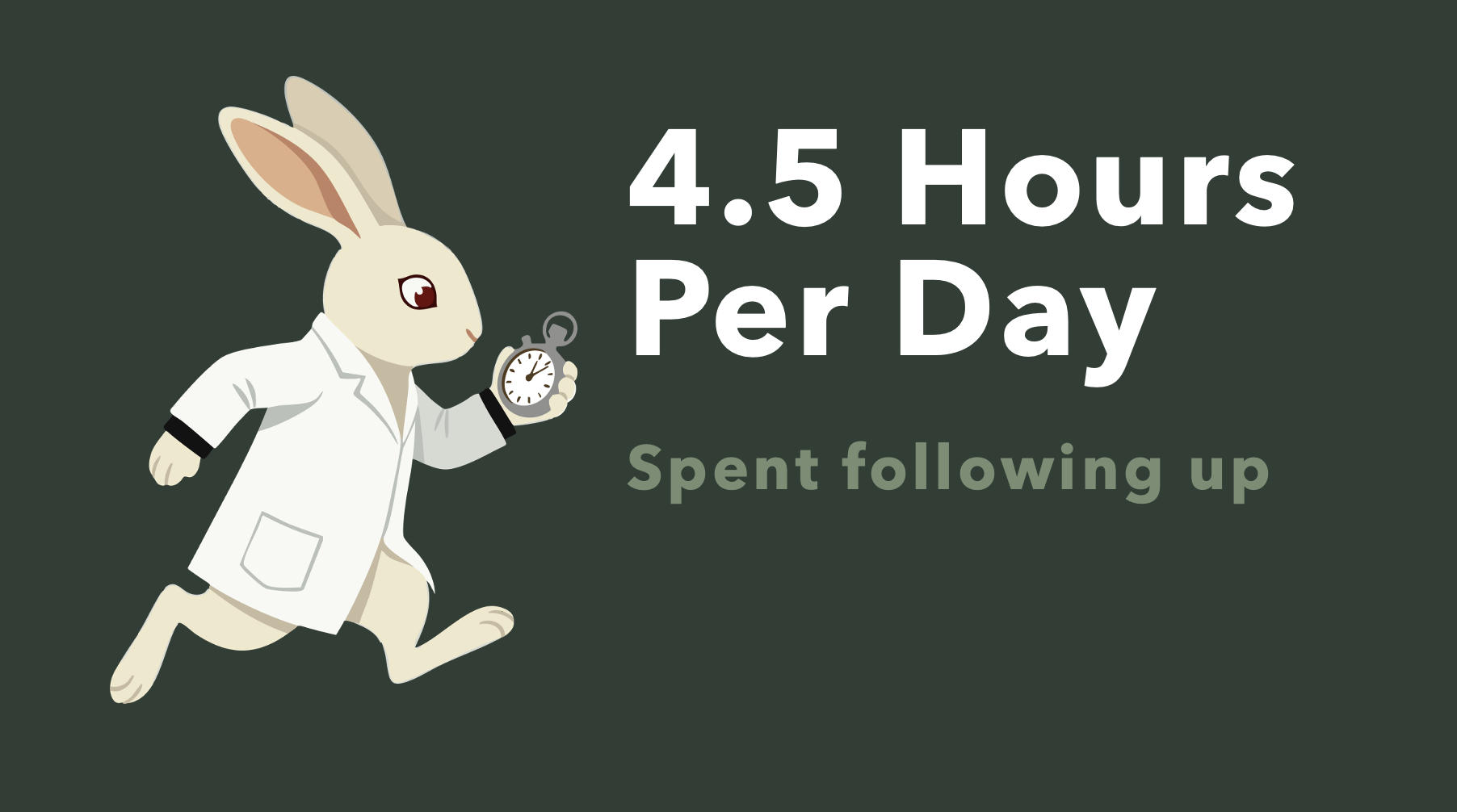
Following up with every patient you discharge, the way the industry's own playbook recommends, costs a two-doctor practice about 4.5 staff-hours a day. In wages alone, that is more than 26,000 dollars a year. And it still misses half your owners, because most people no longer answer their phone. In this issue you will see exactly where those hours go, why every follow-up system you have tried has quietly died, and how to get the time back without hiring anyone. | Why every system dies the same death | I have watched clinics try everything. Pen and paper checklists taped near the phone. Task managers inside the PIMS. Blocked hours in the afternoon reserved for callbacks. Almost all of it fails, and it fails for the same reason: follow-up is the one clinical problem that is never physically in front of the doctor. The patient in the exam room always wins. The patient recovering at home cannot compete. | So what survives is memory. The doctor makes a mental note about the critical case, the scary one, and calls that owner personally. Everyone else gets silence. I have written before about what the other side of that silence looks like. When I analysed thousands of Google reviews for US clinics, the pattern was impossible to miss: owners who got a check-in call mention it explicitly, emotionally, and almost always next to five stars. Calling everyone builds reputation and surfaces rechecks. Calling only the cases you remember does neither at scale. | The math, honestly | The average practice runs 15 appointments per day per full-time veterinarian. Two doctors means about 30 patients walking out your door daily. The industry's own guidance says to call every patient from the day before, call surgical and dental cases again around day three, and call medical cases on their own timelines. Follow that playbook and you are attempting 30 or more outbound calls a day. | Now the part nobody budgets for: reaching people. Only 42 percent of people leave a voicemail when their call goes unanswered, and only 18 percent listen to voicemails from unknown numbers. Human hospitals run these programs with dedicated nurses, and even they complete the call with fewer than half of assigned patients. Every attempt burns minutes whether anyone picks up or not. | So here is the true unit cost of one followed-up patient: | Pull the chart, dial, ring out, leave the voicemail nobody will hear, log it: 2 minutes Try again the next day: 2 minutes The actual conversation, when it finally happens: 5 minutes Writing it into the record: 2 minutes Cost per patient: about 9 minutes |
|
| Now scale it: | 9 minutes × 30 patients = 4.5 staff-hours. Every day. 4.5 hours × 5 days × 52 weeks = 1,170 staff-hours a year. 1,170 hours at technician wages of 22 to 28 dollars an hour = 26,000 to 33,000 dollars. Per year. |
|
| Read those numbers again. More than half of one employee's entire shift, every single day, on the phone. Roughly half a technician's annual salary, paid out for calls that mostly ring out. And at the end of it all, fewer than half your owners were actually reached. | Cut the protocol down to 20 patients a day and you are still at three hours and around 20,000 dollars. The math does not get kind. It just gets slightly less brutal. | Why the front desk cannot absorb this | The default answer is to hand the list to reception. Four things break immediately. | There is no slack in that seat. The average clinic already misses about one in four incoming calls. An outbound list competes with a phone that is already losing, and on busy days the list is the first casualty. That is why it dies by Wednesday. | The work is interruption. A receptionist mid-callback is also checking in a patient, answering line two, and taking a payment. Research on interrupted work shows the switching itself carries a heavy cost in time and stress, on top of the minutes you can count. | There is no clinical judgment at the desk. The best version of front-desk follow-up I have seen was a text that read "is Leo doing okay." A receptionist is not trained to ask about incision appearance or appetite or the medication schedule, and here is the harder truth: the owner does not know what to look for either. Two people who cannot name the warning signs are reassuring each other. The moment an owner says "he is still not eating," the receptionist can only take a message, and a three-person relay begins. Your front desk should be free for the clients standing in your lobby, not glued to a phone. | The timing is wrong. One practice owner who does his own callbacks swears the magic window for reaching clients is 9 to 9:30 pm, after dinner, before bedtime. Your clinic is dark at 9 pm. And even that window guarantees nothing. | Please do something | Something is genuinely better than nothing. If manual is all you have, protect it: give the list to a technician rather than the desk, batch the calls into one defended block, and start with surgical and medical cases only. Your critical-case memory system is real care. Keep it. | But listen to what the math is telling you. The scarcest resource in this industry is the staff-hour. Staffing is the top operational challenge practices report, and 65 percent of practices have already reduced hours or services because of it. Spending 1,170 of those hours a year dialing numbers that mostly ring out is the worst possible use of your best people. | This is the workflow we built Nidana Loop to carry. Instead of your team ringing owners repeatedly, Loop texts the owner a link and they start the call whenever suits them, at 9 pm or 6 am, and because it holds the case details, it asks the questions a receptionist cannot. Your staff see only the summaries and the patients flagged for a recheck. The 4.5 hours go back to the patients in your building. | Curious what that looks like for your clinic? Book a 20-minute demo. |
|